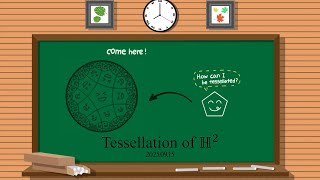
2025 Fall / 2025.09.15.
H²의 테셀레이션
초록
"평면을 정오각형으로 빈틈없이 겹치지 않게 채울 수 있다면 믿으시겠습니까?"
주어진 다각형이 공간을 빈틈없이 채우는지 어떻게 알 수 있을까요? 단순히 다각형을 여기저기 붙여보면 됩니다. 이때 ‘여기저기 붙인다‘는 것은 다각형을 평행이동 등의 함수로 옮겨주는 것으로도 생각할 수 있습니다.
이러한 관점은 상상하기 어려운 쌍곡평면(H²)의 tessellation 문제를 이해하는 데 도움을 줍니다. 즉, ‘어떤 다각형이 H²를 채우는가?’라는 질문이 군의 존재성에 대한 대수적 질문으로 바뀝니다. 그리고 Poincaré polygon theorem은 한 가지 구체적인 답을 제시합니다.
이번 발표는 H²의 개념에서 시작해 수학적 형식화를 거쳐 Poincaré polygon theorem의 구체적 내용까지 다룹니다. 이 과정에서 기하적 직관과 대수적 구조가 흥미롭게 맞물리는 모습을 볼 수 있습니다.
Abstract
"Would you believe that a plane can be tiled perfectly with regular pentagons—without gaps or overlaps?"
How can we determine whether a given polygon can tile a space without gaps? One simple approach is to try attaching copies of the polygon in different places. Here, “attaching them in different places” can also be viewed as moving the polygon using transformations such as translations.
This perspective helps us understand the tessellation problem on the hyperbolic plane H2, which is otherwise difficult to visualize. In other words, the question “Which polygons tile H2?” can be transformed into an algebraic question about the existence of certain groups. The Poincaré Polygon Theorem provides one concrete answer to this question.
This talk begins with the concept of H2, moves through its mathematical formalization, and then discusses the specific content of the Poincaré Polygon Theorem. Along the way, we will see how geometric intuition and algebraic structure interact in an intriguing way.
Video Link