2026 Spring / 2026.04.06.
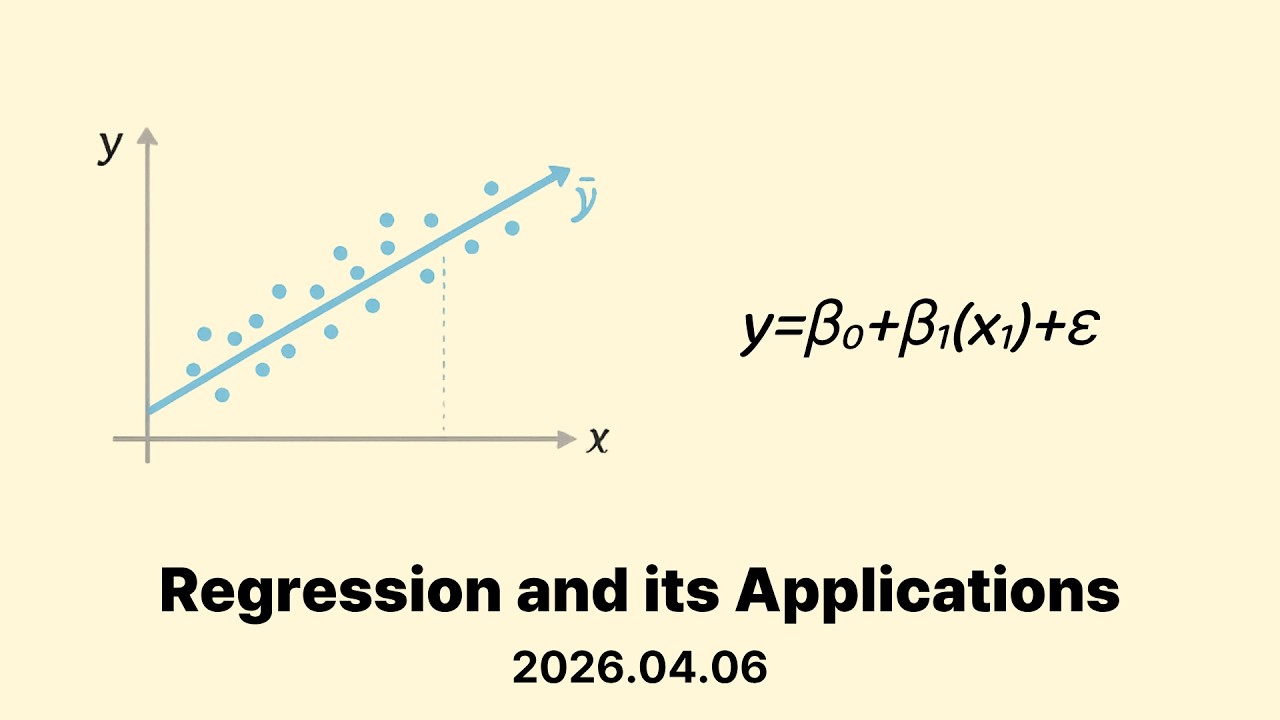
회귀분석과 적용
초록
"가진 데이터로 미래 예측하기: 회귀분석의 이론, 해석 그리고 활용"
회귀분석은 흔히 자료 위에 가장 잘 맞는 직선을 그리는 방법으로 소개되지만, 해석에선 가설검정과 신뢰도로 설명됩니다. 회귀모형은 변수들 사이의 관계를 정량적으로 설명하고, 관측되지 않은 값을 예측하며, 데이터에 내재한 불확실성까지 함께 다루는 통계학의 핵심 언어입니다. 이번 세미나에서는 회귀분석의 기초인 단순선형회귀와 다중선형회귀를 중심으로 회귀계수의 해석, 오차의 의미, 설명력의 측정과 같은 기본 개념을 차례로 정리하고자 합니다. 이어서 다중공선성 문제에 대응하는 Ridge 회귀, 변수선택의 성격을 갖는 LASSO 회귀, 그리고 범주형 반응변수를 다루기 위한 로지스틱 회귀까지 소개하면서, 고전적 선형회귀가 어떻게 더 넓은 통계적 모형으로 확장되는지 살펴볼 것입니다. 이 과정이 결정이론을 통해 타당함을 이해한 후, 마지막으로 시계열데이터, 머신러닝과의 연결을 통해 회귀분석이 오늘날 데이터 분석 전반에서 어떤 역할을 하는지 함께 살펴보고자 합니다. 이를 통해 회귀분석을 하나의 계산 기법이 아니라, 데이터를 이해하고 미래를 추론하는 통계적 사고의 구조로 바라보는 시간을 마련하고자 합니다.
Abstract
"Predicting the future with the data you have: the theory, interpretation, and use of regression"
Regression analysis is often introduced as a way of drawing the best-fitting line through data, but its interpretation relies on hypothesis testing and confidence. A regression model is a core language of statistics that quantitatively describes the relationships between variables, predicts unobserved values, and accounts for the uncertainty inherent in data. In this seminar, we will first organize the basic concepts of regression, centered on simple and multiple linear regression, including the interpretation of regression coefficients, the meaning of error, and the measurement of explanatory power. We will then introduce Ridge regression, which addresses multicollinearity, LASSO regression, which performs variable selection, and logistic regression, which handles categorical response variables, examining how classical linear regression extends into broader statistical models. After understanding why this extension is justified through decision theory, we will finally look at how regression analysis functions across today’s data analysis landscape through its connections to time-series data and machine learning. Through this, we hope to view regression not merely as a computational technique, but as a structure of statistical thinking for understanding data and inferring the future.
Video Link